Empower Visually Impaired Users with Ultrasonic Vision!
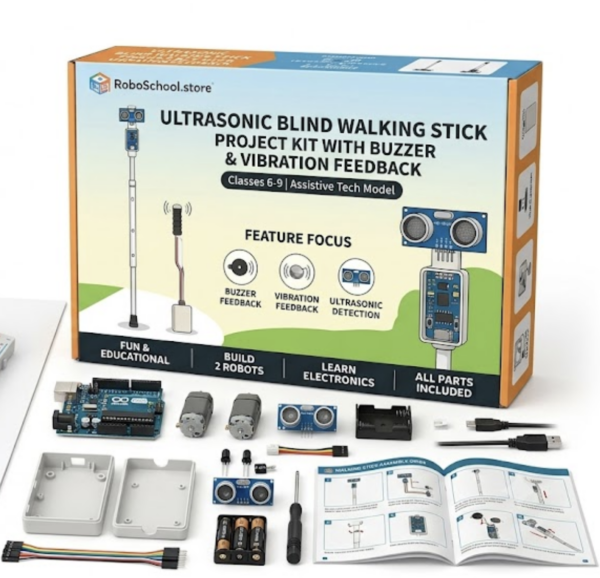
Judges at national competitions love social-impact innovations! This assistive technology working model measures real-time distance using high-frequency sound waves. When an obstacle is detected within 100 cm, it instantly alerts the user via an audible piezo buzzer and a tactile haptic vibration feedback motor.
🌟 Why Choose This Ultrasonic Blind Walking Stick Kit?
|
🦯
Assistive Social Tech
Demonstrates real-world biomedical engineering and inclusive design for accessibility.
|
📳
Haptic & Sound Alerts
Dual warning output system using a 5V piezo audio buzzer and a coin-type micro vibration motor.
|
|
🔌
100% Solderless Safety
Child-safe plug-and-play breadboard circuits with jumper wires. Zero soldering irons or toxic materials.
|
🏆
Science Exhibition Winner
Top-scoring working model for school science fairs, INSPIRE Awards, and inter-school STEM competitions.
|
🏛️ Mandatory Kit for School Robotics Labs & Screen-Free Home DIY
Essential social-innovation model compliant with national education grants, school innovation labs, and hands-on home tinkering:
- PM SHRI Schools (PM Schools for Rising India): Fully complies with PM SHRI directives for social-impact practical computing and assistive technology models under NEP 2020.
- Atal Tinkering Labs (NITI Aayog ATL): Standard hardware item for ATL Level-1 & Level-2 Ultrasonic Sensor Integration and Haptic Transducer modules.
- School STEM & Social Innovation Clubs: Top-recommended practical project to demonstrate physical computing, transducer feedback, and community-centered engineering.
- Best Screen-Free DIY Gift: Replaces passive screen time with hands-on building—includes step-by-step visual guides, circuit schematics, and an exhibition report template.
📚 Pan-India Board Syllabus & School Standards
Directly mapped to prescribed science chapters for Classes 6 to 9 across Indian National & State Boards:
- CBSE / NCERT (Classes 6–9): AI & CS Codes 083/417 (Sensor Interfacing & Conditionals) and Physics units on Reflection of Sound, ECHO Equations ($v = \frac{2d}{t}$) & Simple Circuits.
- ICSE Board (Classes 8–9): Subject Code 66 (Robotics & AI — Transducers, Ultrasonic Rangefinders & Acoustic Output Units).
- Kerala SCERT (Samagra – Class 8 ICT): Directly matches ICT Chapter 7 ‘World of Robots’ and Physics units on Production & Propagation of Sound.
- Maharashtra MSBSHSE (Balbharati – Classes 6–9): Science & Tech Chapter ‘Sound, Echo Location, Electric Current & Sensor Applications’.
- Karnataka KSEEB, Tamil Nadu TNSCERT, AP & TS SCERT: Science & Computer Technology practical units on ‘Ultrasonics in Daily Life & Assistive Electronics’.
📐 Technical Specifications
| Ranging Sensor |
HC-SR04 Ultrasonic Sensor Module (2cm to 400cm Range) |
| Haptic Feedback Motor |
Micro Coin-Type ERM Vibration Motor + Driver Transistor |
| Acoustic Alert |
5V Active Piezo Sound Buzzer Module |
| Circuit Assembly |
100% Solderless Breadboard & Jumper Wiring Layout |
| Power Requirements |
Child-Safe Low-Voltage DC Battery Holder Included |
❓ Frequently Asked Questions (FAQs)
Q1: What is the Ultrasonic Blind Walking Stick Project Kit with Buzzer & Vibration Feedback (Classes 6-9) | Assistive Tech Model and how does it work?
A: The Ultrasonic Blind Walking Stick Project Kit with Buzzer & Vibration Feedback (Classes 6-9) | Assistive Tech Model is an educational hands-on STEM project designed to teach physical computing, sensor integration, and real-world science concepts through practical assembly. It emits ultrasonic sound waves from a stick-mounted sensor; when an obstacle reflects those waves back from within 1 meter, the system activates an acoustic buzzer and a haptic vibration motor to alert visually impaired users.
Q2: Is prior coding or soldering required for this kit?
A: No soldering is required! The kit features 100% child-safe, plug-and-play breadboards and jumper wiring. Depending on the grade level, it comes pre-programmed or includes easy Scratch/C++ code templates.
Q3: Which school syllabi and boards is this kit aligned with?
A: Aligned with CBSE (Middle School AI & CS Code 083/417), ICSE (Subject Code 66 Robotics & AI), Kerala SCERT (Class 8 ICT ‘World of Robots’), Maharashtra MSBSHSE, Tamil Nadu, Andhra Pradesh, Telangana, and Karnataka State Boards, as well as PM SHRI Schools and NITI Aayog ATL Labs.
Q4: Can this project be submitted for school science exhibitions and INSPIRE Awards?
A: Yes! It is a top-scoring working model for school science fairs, inter-school STEM competitions, and national awards. Includes a pre-formatted project report outline.
Q5: Is this kit suitable as an educational screen-free birthday gift?
A: Absolutely! It replaces passive smartphone screen time with hands-on invention and spatial reasoning, arriving packed in a gift-ready STEM box with a bonus sticker pack.
Q6: Are batteries and step-by-step manuals included in the box?
A: Yes, every kit includes a color-printed assembly guide, circuit diagrams, power battery holders, and all structural chassis/electronics components.
Q7: What technical support is available if we get stuck during assembly?
A: RoboSchool provides direct WhatsApp chat and video technical assistance across India to guide students and parents through circuit connections.
Q8: How fast is shipping across tier-1, tier-2, and tier-3 towns in India?
A: We deliver in 3 to 5 business days across 20,000+ pincodes in all 28 states and Union Territories via express courier partners.
Q9: Can teachers and schools place bulk lab orders with GST tax invoices?
A: Yes! We supply school robotics labs, Atal Tinkering Labs (ATL), PM SHRI Schools, and STEM clubs across India with B2B GST tax invoices and volume discounts.
Q10: Why choose RoboSchool for STEM robotics kits?
A: RoboSchool provides 100% pre-tested components, curriculum-aligned learning, dedicated assembly support, and fast express shipping across India.

Reviews
There are no reviews yet.